JJ CCR Crossover
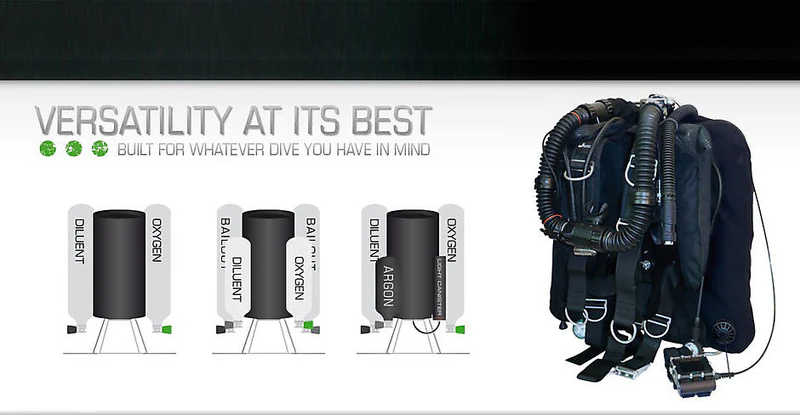
This crossover course is designed to take the experienced CCR diver and introduce them to the JJ CCR unit. Using the latest technology, CCRs can maximize your gas supply and provide an optimum breathing gas for any depth by maintaining a constant partial pressure of oxygen. It’s like having a nitrox blending machine on your back!
During this course, your TDI Instructor will teach you all of the necessary skills to conduct no decompression CCR dives to a maximum depth of 30 metres/100 feet using air diluent.
What you can expect to learn
JJ CCR Crossover course takes an in-depth look at all of the following and more:
- History and evolution of rebreathers
- Comparison of open circuit (OC), closed circuit, and semi-closed circuit, rebreather (SCR) systems noting the pros and cons of each
- Practical mechanics of the system
- Gas physiology
- Proper scrubber packing: in accordance with manufacturers recommendation
- Electronic or manual systems design and maintenance
- Dive tables
- Dive computers
- Dive planning
- Emergency procedures
- Dive checklists
- Predive checks
Some of the required skills you will have to demonstrate include all of the following and more:
- All open water dives must be between 9 metres/30 feet and 30 metres/100 feet
- Two dives must be deeper than 20 metres/50 feet and one dive must be deeper than 27 metres/90 feet
- Partial pressure of oxygen not to exceed manufacturers recommendation or a working limit of 1.3
- All dives to be completed within CNS percentage limits with a recommend maximum of 80 percent of the total CNS limit
- Where the user opts for an automatic diluent valve (ADV) fitted and approved by the manufacturer, additional skills such as regular diluent gauge monitoring and addition control must be emphasized
- Unit build up and break down
- Predive checks
- Verify diluent and oxygen contents using an analyzer
- Demonstrate correct predive planning procedures
- Cover emergency procedures
- Use of BCD/dry suit and effective management of loop breathing volume for buoyancy control
- Stop at 13-6 metres/ 10-20 feet on descent for leak/bubble check
- Electronic system monitoring for partial pressure of oxygen levels (set point) and switching set points
- Use of lift bag, or surface marker buoy and reel, where appropriate
- Proper execution of the dive within all pre-determined limits
- Demonstration of safety stops at pre-determined depths
- Constant loop volume management
- Post dive clean of unit
- Diver maintenance of unit
Course prerequisites
Minimum age 18.
2. Provide proof of 20 logged open water dives. If completing a unit crossover, provide
proof of 10 logged CCR dives in the last 12 months.
3. Provide proof as a TDI Nitrox Diver or equivalent from agencies recognized by TDI. *
4. If the rebreather is a TDI approved Sidemount rebreather, the student must hold the
TDI Sidemount Diver certification or equivalent, provide proof of 10 logged Sidemount
dives, and any additional requirements the Sidemount rebreather manufacturer may
have.
How long will this take?
If a student is already qualified as a TDI Air Diluent CCR Diver or equivalent wishes to
qualify on another CCR recognized by TDI, the student must follow all unit specific course
standards and meet all skill performance requirements.
The only changes during the unit crossover are:
1. Minimum of 60 minutes confined water training to a maximum of 9 Metres/30 Feet.
2. Minimum of 240 minutes open water training to be completed over a minimum of 4
dives to a maximum depth of 30 Metres/100 Feet.
Want to know more?
Ask more questions or schedule any of these courses Email Us.